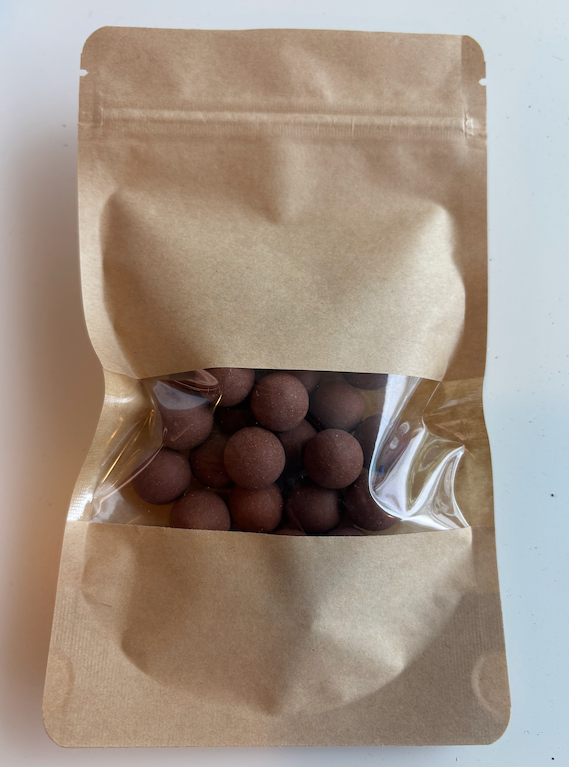
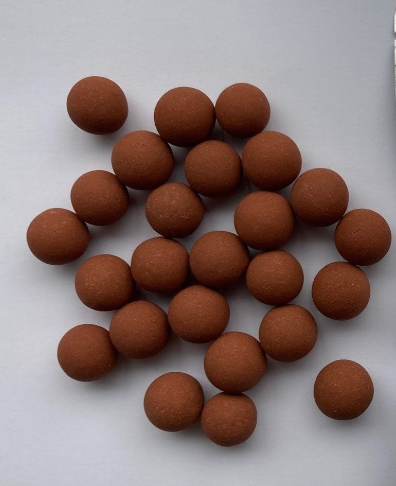
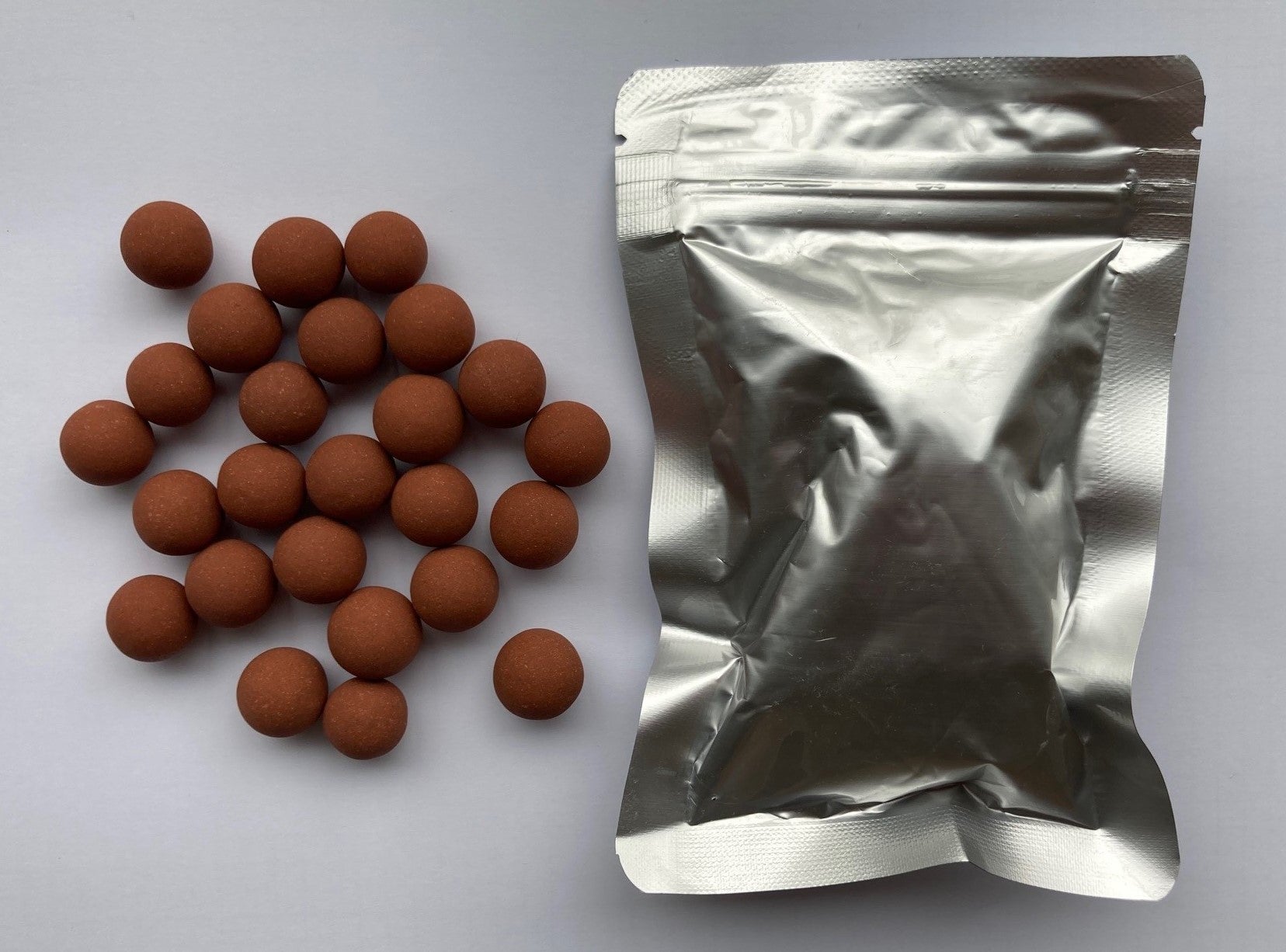
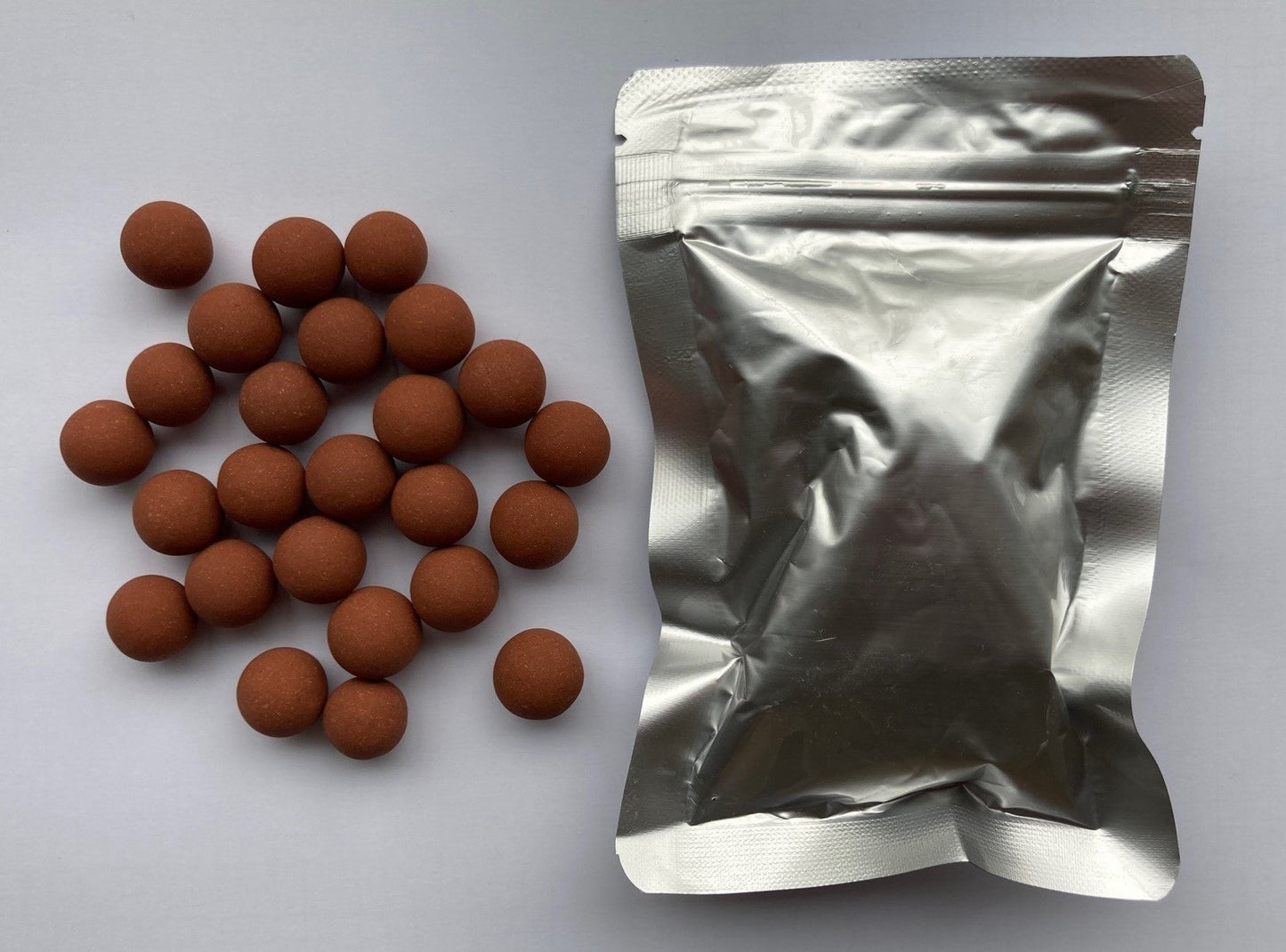
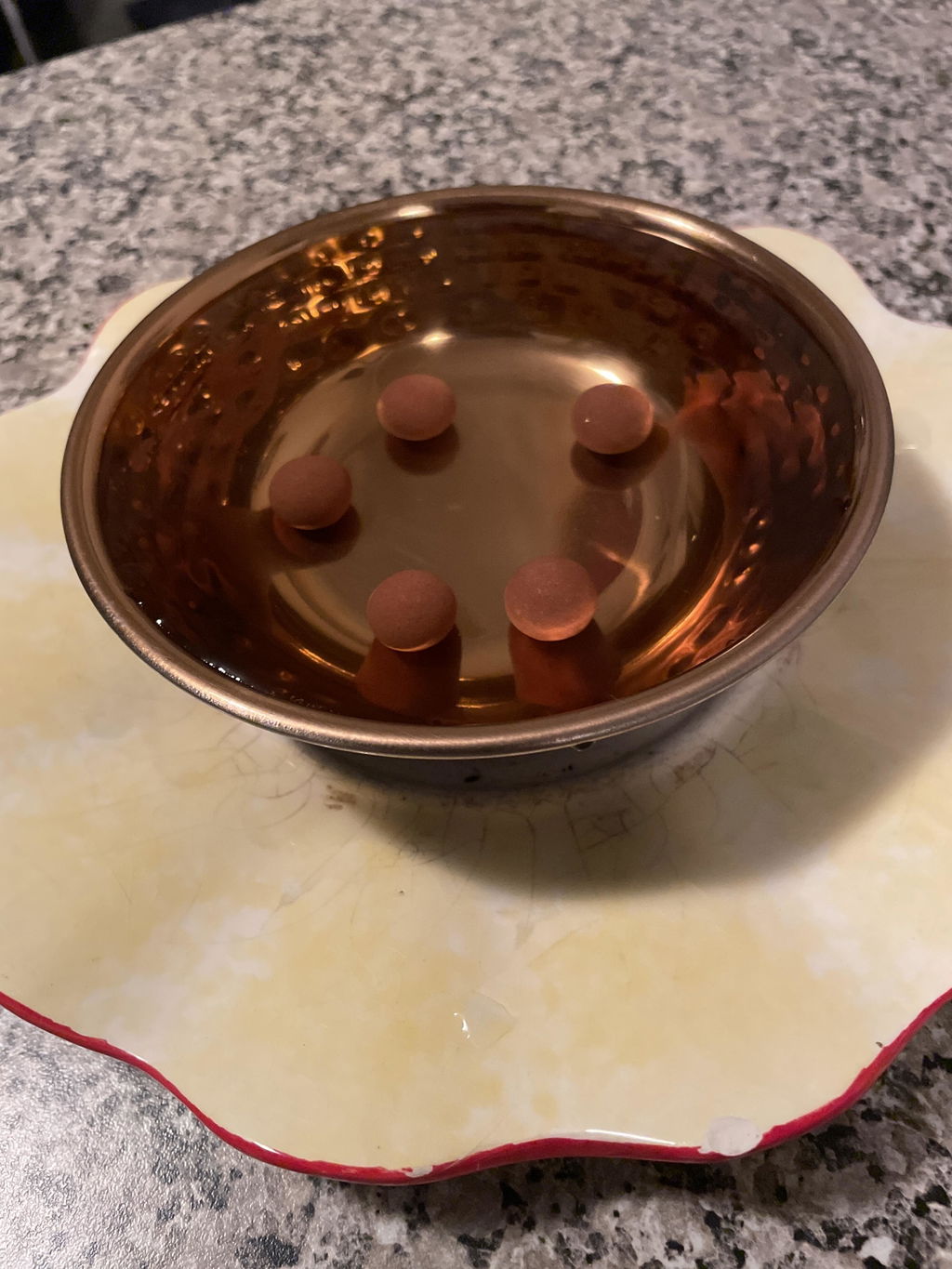
QELBY (Quantum Energy Living Bodies) is a somatid ceramic fired from South Korean clay and stone: ocher, elvan stone, jade, tourmaline, zeolite, kaolin, bentonite and quartz, fired at 1,000 degrees Celsius. QELBY was formerly sold as Somatide. This 200 gram pack is the larger size, made for a jug, a bigger carafe or a whole-house filter.
How to use it
Rinse the balls with water before the first use, to wash off any dust from the firing. Place them in your drinking bottle, carafe, jug or filter. Give it a night: fill up in the evening and leave the balls in the water overnight, then taste it next to a glass of your tap water and decide for yourself.
- A cup of water, tea or coffee: 3 to 4 balls
- A 1 litre bottle: 25 to 50 grams
- A large water jug of around 8 litres: at least 400 grams
- More is better: the more balls in the water, the faster it takes on their character
- Never empty the bottle completely. Leave a little water in and refill on top, so the charged water passes its character on to the fresh water
- They last for years. It is not a filter: many people put the balls in the water that comes out of their filter
What people report
"I have been using the QELBY balls for a few weeks now and have found my energy levels and overall feeling of well being has increased. The taste of the water is just lovely. I have never enjoyed drinking water and always been reluctant to get properly hydrated because of this, but now I am finding the water a joy to drink. Tea tastes much better too! I can thoroughly recommend the QELBY balls and I am looking into getting the whole house water filter too."
Rosalind D., UK
"We immediately noticed the quality of our drinking water was beautifully enhanced. The taste is just gorgeous, smooth and refreshing, a completely different experience from bottled water or in fact any water we have drunk before. Our energy has increased enormously. I am 63 and Liv is 61, we had good health before, but now we both cannot stop. We have asked people to do a blind test and everyone who tries the glass with QELBY notices a big change in the quality and experience."
Shaun and Liv H., Norway
"I was already drinking structured water, but seeing your interview with Mark Attwood, I thought I have to check this out. Firstly I noticed a difference in the taste, it seems to be a lot smoother, and after a few days I felt less fatigued, and a bit more get up and go than normal. I would thoroughly recommend this product."
Paul D.
EZ water, H3O2 and Pollack's research
Water next to a water-loving surface forms a thin layer that pushes out tiny particles, an effect called the exclusion zone, reproduced by several independent research groups. Gerald Pollack, professor of bioengineering at the University of Washington, calls this exclusion-zone water "the fourth phase of water": in his own words, "water has four phases, not three phases." Counting the hydrogen and oxygen atoms in this layer, Pollack proposes the structure H3O2, rather than H2O, and describes it as negatively charged, with the water beyond it carrying the opposite charge, "something that's like a battery."
In 2017, Pollack's laboratory published a study of QELBY powder in Advances in Materials Science and Engineering, funded in part by a gift from Quantum Energy Co., the maker, and a grant from the SAGST Foundation. The study measured exclusion zones averaging 107 micrometres next to hydrated QELBY pellets, against 74 micrometres next to a silica control, growing at about 1 micrometre per second, comparable to the laboratory reference material Nafion. Sprouted chickpea seeds grown for a week in QELBY-treated water developed roots 58 percent longer than seeds grown in silica-treated water.
A second study, co-authored by Pollack and funded by a Quantum Energy Co. grant, published in PLOS ONE in 2018, mixed the ceramic powder into water and measured what changed. In plain terms: the water's redox potential, a measure of how readily it gives up electrons, fell from 312 to 262 millivolts within four hours of contact with the ceramic. Frozen samples viewed under a cryogenic electron microscope showed a honeycomb-like structure that the authors read as exclusion-zone water. The same study measured the powder's own surface charge in water, its zeta potential, at minus 37.7 millivolts, and measured its far-infrared emissivity at 0.927 between 5 and 20 micrometres. The manufacturer describes QELBY as generating negative electrons and microcurrents in water.
Pollack advises anyone curious about structured-water products to ask the company what evidence it has. This is ours: read the full studies, with their funders and figures, in the free QELBY guide.
Specifications
- Fired ceramic clay balls, 200 grams
- Made in South Korea, patented by Lee Jong-doo
- Minerals: ocher, elvan stone, jade, tourmaline, zeolite, kaolin, bentonite, quartz
- Far-infrared emitting: emissivity measured at 0.927 between 5 and 20 micrometres (PLOS ONE, 2018)
- For drinking water, coffee, tea, wine, spirits and travel
Read more in the free QELBY guide: dragonflywatersolutions.com/pages/guides.